Disclaimer
Information provided on this website is general in nature and does not constitute financial advice. Every effort has been made to ensure that the information provided is accurate. Individuals must not rely on this information to make a financial or investment decision. Before making any decision, we recommend you consult a financial adviser to take into account your particular investment objectives, financial situation and individual needs.
A FinSec View – Whiff of a wealth tax? The Empire Strikes Back, Losing your Identity and a Healthy Dose of AI

| 20th February 2026 |
Welcome to 2026
AI, AI, AI — it’s all we hear, and for good reason: it’s rewriting the rules faster than investors can blink.
Every boardroom, every briefing, every dinner table debate loops back to it. But there’s an older story worth remembering as the hype hits fever pitch: Jevons Paradox.
In the 1800s, William Stanley Jevons noticed that as steam engines became more efficient, Britain didn’t burn less coal — it burned more. Efficiency cut the “price” of using energy, and demand exploded.
Fast forward to today’s AI race and the rhyme is hard to miss. Silicon Valley promises smaller models, smarter chips and cooler data centres to tame AI’s footprint. Yet efficiencies don’t shrink usage — they supercharge it. The cheaper, faster and easier AI becomes, the more we ask it to do: real time translation, always on marketing agents, continuous analytics — tasks that were uneconomic yesterday become standard tomorrow.
However, as strategic thinker Gwythian Prins argued in his 2021 essay The Worm in the Rose, every technological triumph carries the seeds of its own complication — his variation on Jevons Paradox. In AI’s case, the “rose” is the alluring promise of a high-tech, low-impact future; the “worm” is the rebound effect. Make AI 50% more efficient and we don’t save 50% of the energy — we make it 50% cheaper to deploy, unleashing a tidal wave of new demand.
For investors, that’s the front-of-mind point. Efficiency won’t dampen AI; it will scale it. And the enduring opportunities may sit where silicon meets steel: the data centres, grids and high density energy sources that keep the algorithms alive!
So with all that in mind, we welcome you to the first edition of The View for 2026. Inside, you’ll find our market update, a few key pieces of super news, a confronting piece on losing your identity and of course — a healthy dose of AI.
Market Update
Australia
The beginning of 2026 has brought a sharp shift in the Australian economic narrative. While the final weeks of 2025 were defined by a “wait and see” approach, the events since mid-January have seen the Reserve Bank of Australia (RBA) move decisively to combat stubborn price pressures.
In a significant move for borrowers and investors alike, the RBA raised the official cash rate by 25 basis points to 3.85% at its February 3 meeting. This marked a shift from the steady rates seen at the end of 2025. Governor Michele Bullock maintained a hawkish stance, noting that inflation risks remain to the upside. This decision was largely driven by the December quarter CPI data, which showed headline inflation rising to 3.8%, fuelled by persistent increases in housing, recreation, and insurance costs.
Markets have quickly adjusted their expectations. Earlier hopes for rate cuts have been replaced by the reality of “higher for longer,” with many analysts now pricing in the possibility of further hikes in the first half of the year if the labour market remains tight.
The local share market experienced a volatile start to the year. Following the holiday break, the S&P/ASX 200 surged to a three-month high in late January, reaching 8,955 points. This rally was underpinned by a resurgent materials sector, with mining giants like BHP and Rio Tinto benefiting from strong commodity prices and optimism regarding Chinese economic support.
However, this momentum stalled in February. The combination of the RBA’s rate hike and a nervous global backdrop—particularly surrounding US trade policy and tech valuations—triggered the sharpest one-day sell-off since early 2025. Nearly $70 billion was wiped off the ASX boards in a single Friday session (February 6) as investors went into “sell everything” mode, amid fears of slowing global growth. After dropping 2% to close at 8,709 points, it managed a partial rebound of roughly 1.5% the following Monday.
Resources remained a bright spot for much of the period, driven by Gold hitting record highs over US$5,600 per ounce and gains in copper and silver. The “Big Four” banks have faced mixed fortunes; while some reached record highs earlier in the year, valuations are appearing stretched under the weight of higher interest rates.
Australian tech firms face headwinds as global “AI jitters” and concerns about high capital expenditure on the Nasdaq have spilled over into local tech stocks. The Energy sector also struggled as Brent crude prices softened amid oversupply concerns, though local players like Santos found support from new project milestones.
On a bright note, the AUD pushed through US$0.70, the first time since early 2023, supported by widening interest rate differentials and higher base metal prices.
As we move into the heart of the February reporting season, the focus shifts to corporate earnings and how businesses are navigating higher input costs and a cooling consumer. We will be watching the upcoming employment data closely, as any signs of a loosening labour market could be the catalyst the RBA needs to pause its current tightening cycle.
Global
So far this year, we’ve seen a significant broadening of market leadership and a dramatic shift in currency and commodity dynamics. While 2025 was dominated by a concentrated rally in US mega-cap technology, the current environment is characterised by a rotation into emerging markets, small caps, and defensive sectors.
US equities started the year on a positive note, with the S&P 500 crossing the historic 7,000-point milestone for the first time in late January. However, the rally has changed shape. The “Magnificent 7” technology giants, which spearheaded gains last year, have faced recent headwinds from valuation concerns and potential tariff impacts.
Instead, leadership has shifted to Energy (+14.2%), Materials (+8.6%), and Financials, as investors look toward cyclical resilience. A key driver of market sentiment was the nomination of Kevin Warsh to succeed Jerome Powell as Fed Chair, a move interpreted by many as hawkish, which immediately led to higher bond yields and a temporary stabilisation of the US dollar.
While US gains were more modest, international markets outperformed in local terms:
Emerging Markets: EM equities surged 3.6% in AUD terms in January, bringing 12-month returns to a stellar 27.2%. South Korea remains a standout performer, supported by its semiconductor and automotive leaders.
Super Update: Whiff of a wealth tax about it?

While the Government’s revised Division 296 superannuation tax may have dispensed with the most contentious element of its original design — the plan to tax unrealised capital gains – it has the whiff of a wealth tax about it.
Why? Because the effective tax rate on earnings, including any realised capital gains, is tied to the total superannuation balance and not just the earned income itself.
Though technically not a wealth tax, because you must still earn income to be exposed to Division 296, the larger your Total Superannuation Balance, the higher the effective tax rate becomes – a tax on accumulated earnings by any other name.
But perhaps the most troubling element is the impact it could have on the family estate.
Under the revised rules, on death — in additions to the “death tax” applied to the taxable component of the balance there will be a trigger for much higher tax rates. Currently, when a fund member passes away, assets are often sold to pay beneficiaries, resulting in a 10% capital gains tax within the fund. Under Division 296, these same sales could now be taxed at up to 40%.
Add to this the “spouse trap” and again we seem to have a design outcome that is at odds with the historical purpose of super.
Under revised rules, if a couple have $2.0 million each in super and one partner passes away and their super reverts to the survivor, the survivor’s balance could suddenly jump to a “taxable” $4 million. This transforms what was once a tax-free inheritance into a lifelong tax liability for the surviving spouse.
For higher balance members, the era of ‘’set and forget” has been over for some time and its just got more complicated. Thoughtful navigation, particularly around estate transfers, become more essential than ever.
The revisions come into effect 1 July 2026, but the first assessments aren’t expected until late 2027.
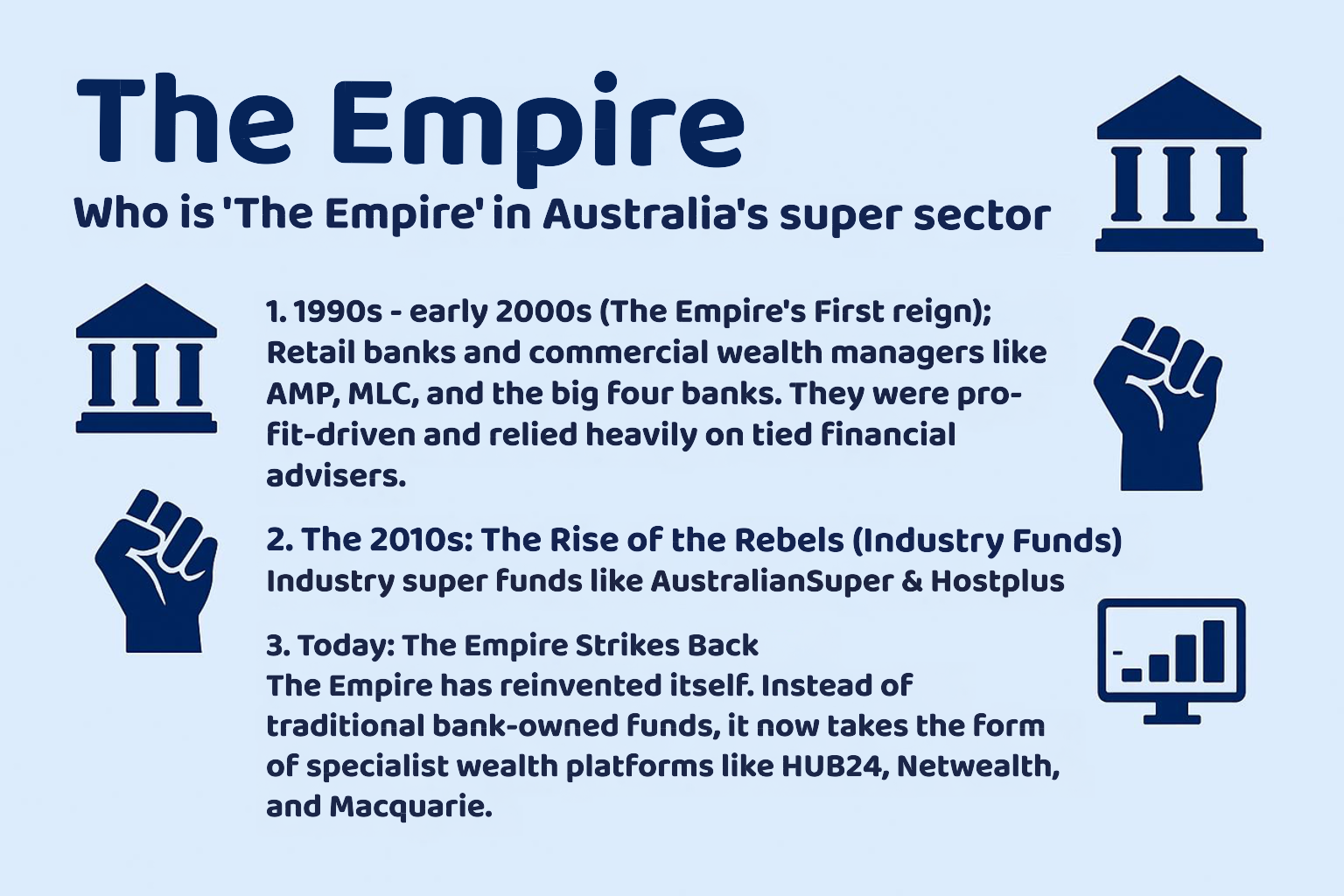
Things that make you go mmm…The Empire Strikes back

Earlier this month, it was revealed that Australian Super — the country’s largest super fund — is losing more members (and more money) to rival funds than ever before. Outflows totalled a net loss of $250.8 million, a stark turnaround from the $15 billion net inflow it recorded only a few years earlier (AFR, 6 Feb 2026).
What’s driving the shift? Adviser-focused platforms (such as HUB24, Netwealth and Panorama) are now offering “super for life” solutions where the real advantage is portability. Clients can begin with a simple, low-cost option and seamlessly transition to a broader investment menu as their circumstances evolve — without triggering extra fees, CGT events or the need to open a new account. In effect, the platform grows with you throughout your entire wealth journey.
At the same time, it’s becoming increasingly clear that industry funds are no longer the undisputed giants of the super landscape. Gen X — the first generation to spend their full working lives under the Super Guarantee — is now approaching retirement with average household balances around $600,000. Naturally, many are seeking more personalised advice and gravitating toward adviser-led platforms that offer greater flexibility, transparency and support.
The moral of the story: when your super grows up, it wants better options too!
If you have children in their 20s or 30s, now is the ideal time to explore the new ‘super for life’ options. Please contact your adviser to discuss further.
The CGT debate: “simplification” over substance
The View has been following Australia’s housing availability and affordability crisis for some time and has observed the limited impact that many government interventions are having.
A recent article by Scott Phillips of The Motley Fool caught our attention, given the current Parliamentary focus (initiated by the Greens) on scrapping or reducing the 50% capital gains tax (CGT) discount on property investment. Phillips argues that removing the discount is the “wrong way” to improve housing affordability; it will only have a minor effect and won’t address the deeper causes of the crisis.
He claims that the 1999 shift from “the CGT Discount” being indexation based (adjusting for inflation) to a flat 50% discount was a political move disguised as “simplification”. He likens a small change to CGT to an alcoholic cutting back – it’s “better than nothing” but doesn’t address the root problem (the supply and demand imbalance).
Phillips recommends that Australia revert to the pre-1999 method of adjusting the cost base for inflation. This approach ensures investors pay tax on “real” gains rather than “nominal” gains caused by inflation.
He also states that negative gearing has a much stronger influence on investor behaviour than the CGT discount, observing that while he rarely hears investors cite it as their main reason for buying a second or third property, “countless” investors point to negative gearing (the ability to offset property losses against taxable income) as the primary motivation. He views negative gearing as a more significant lever affecting affordability because it lowers the “entry barrier” by providing immediate tax relief, thereby increasing competition and upward pressure on prices.
Phillips nevertheless argues that the only way to “meaningfully and quickly” fix affordability is to address the numerical imbalance between households and dwellings. He advocates a temporary pause or significant reduction in Australia’s current immigration intake, clarifying that this is not advocated on xenophobic grounds but rather “in numerical terms” to allow supply (which has long construction lead times) to catch up.
He uses a simple model: 11 households for 10 dwellings causes prices to spike; 9 households for 10 dwellings causes prices to fall.
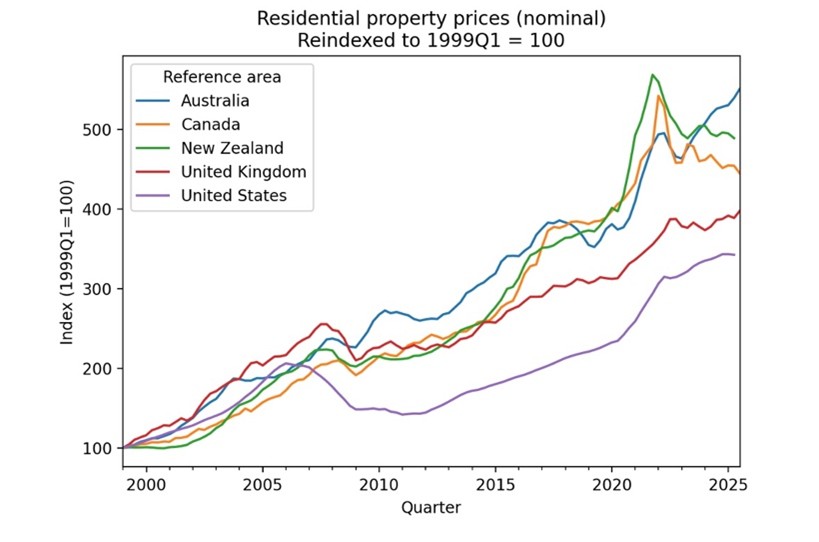
Phillips also identifies borrowing power as a hidden driver of price growth. When interest rates fall, buyers don’t enjoy lower repayments; instead, they ask banks, “How much more can I borrow?” This extra cash is then bid into the market, driving prices higher. He suggests that the banking regulator (APRA) should enforce stricter lending rules to prevent this cycle of ever-increasing debt from inflating property values.
To put Phillips’ arguments into a broader context with recent data:
- Supply vs Demand: As of early 2026, the gap remains stark. While the National Housing Accord aims for 240,000 new homes annually, national commencements in 2024-2025 hovered closer to 168,000.
- Lending Trends: In late 2025, APRA introduced a 20% cap on high debt-to-income (DTI) loans (where debt is 6x income or more), effective February 2026. This aligns with Phillips’ call for regulatory intervention to cool investor-driven price surges.
- Investor Growth: In NSW specifically, lending to investors grew by 972% since 1994, compared to only 392% for first-home buyers.
Chart(s) of the Month
2025 proved the market can rally through just about anything — trade shocks, geopolitical noise, even valuation panic. Strong earnings and AI enthusiasm pushed equities higher, but 2026 brings a new set of questions. Will central banks split paths? Is AI overheating? And what do rising tensions in Iran, Venezuela and Greenland really mean for markets? This week’s charts break it down.
(Chart Source: Australian investment platform, Betashares)
- Global policy divergence
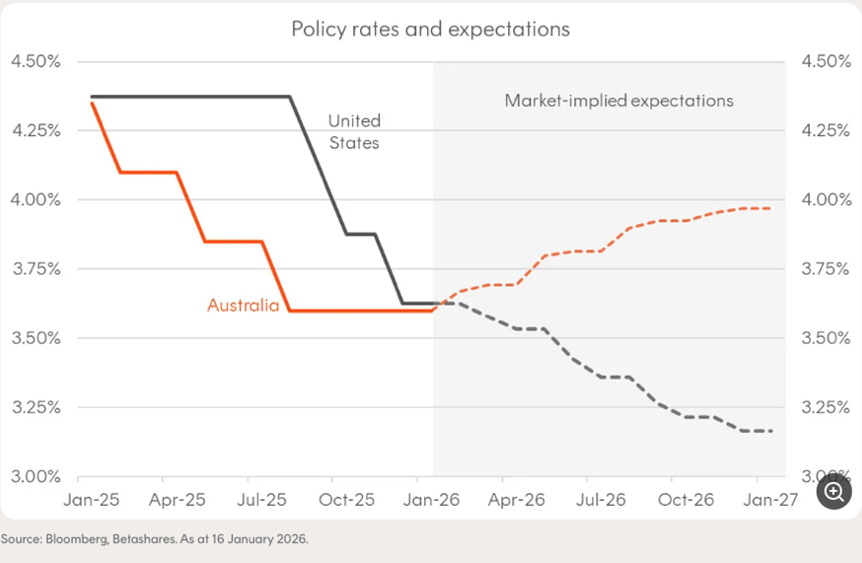
A big shift is hitting fixed income markets: global interest?rate paths are no longer moving together. After years of central banks easing in unison, the outlook has split.
Markets now expect Australia, Canada and New Zealand to lean toward tightening as inflation lingers, while the US Federal Reserve is still tipped to cut. Whether that actually plays out is anyone’s guess — but the impact won’t be small. Diverging rate paths will drive bond returns, shake up currencies, and reshape hedging decisions through 2026.
2. Can the RBA keep inflation under control?
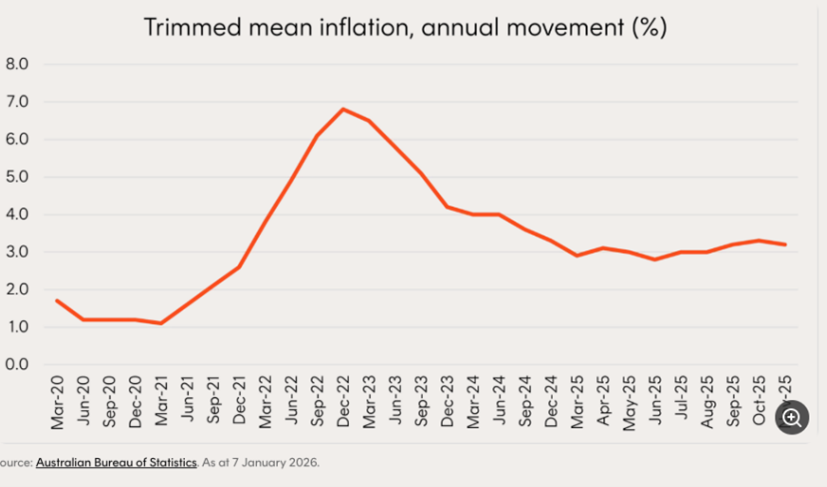
A big swing factor for Australia in 2026 is inflation. Yes, price pressures have ticked up again, but much of that looks temporary — things like global food price spikes and short?term home?builder discounts should fade out. At the same time, higher borrowing costs are already squeezing profit margins and cooling consumer spending, which should help take further heat out of inflation. Put it all together, and the RBA may have no room for a rate cut this year.
3. Is US employment growth a canary in the coal mine or another false recession indicator?
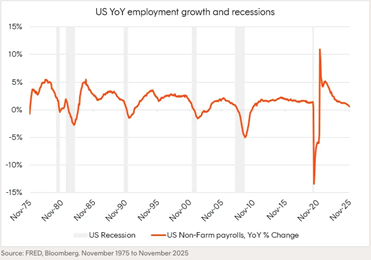
US job growth has slowed to just 0.6% over the past year — the weakest pace since early 2021. Normally, that sort of deceleration is a red flag, often appearing right before a recession and a jump in unemployment. But this time, the signals are anything but straightforward. The data has been muddied by government shutdown noise, job cuts, deportations and lower immigration, making it harder to get a clean read on what’s really happening.
So the big question heading into 2026 is this:
Does soft employment signal genuine trouble for the US economy — or is it just another false alarm in a cycle that has defied recession calls again and again?
4. Will the AI capex juggernaut continue?
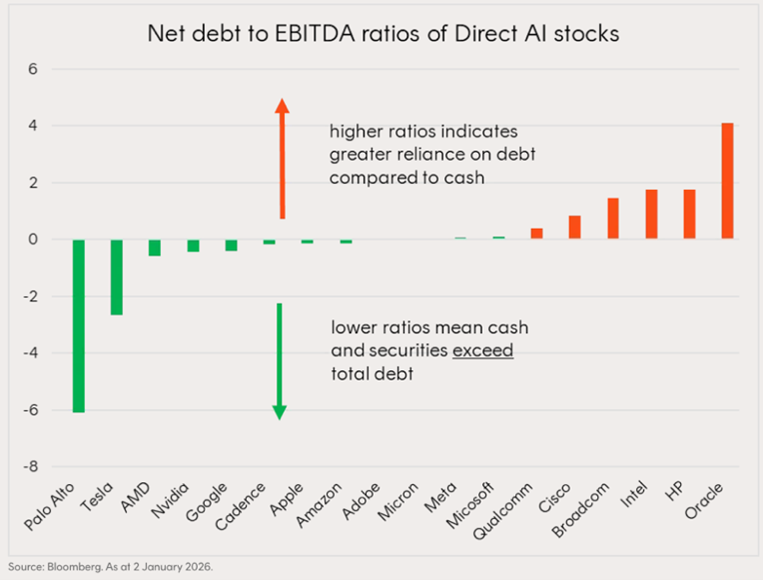
The AI spending boom is still roaring, and for now, most of the heavy lifting is being funded by the megacap tech giants’ own cash flows. But there’s growing chatter about the rise in debt issuance as companies look for cheaper capital to fuel the next leg of AI investment.
The good news? These firms can afford it. Their balance sheets remain incredibly strong, and many of them still have negative net-debt-to-cash-flow ratios — meaning they generate more cash than they owe. In other words, they have plenty of room to borrow without compromising their financial foundations.
5. Investing beyond the US
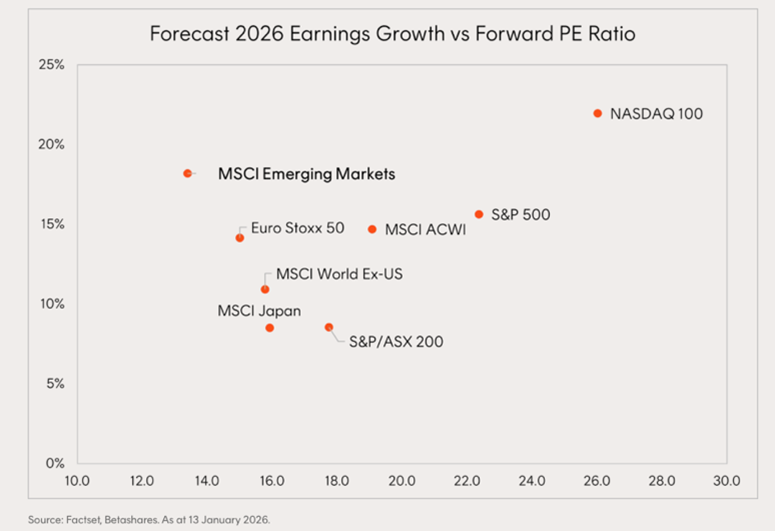
Global investors have been underweight Emerging Markets for years — but momentum is finally shifting. Sentiment is improving, money is starting to flow back in, and the fundamentals are hard to ignore. EMs are now offering Nasdaq-level earnings growth at roughly half the price, making them one of the most compelling value-meets-growth opportunities on the global stage.
6. Friend or Foe?
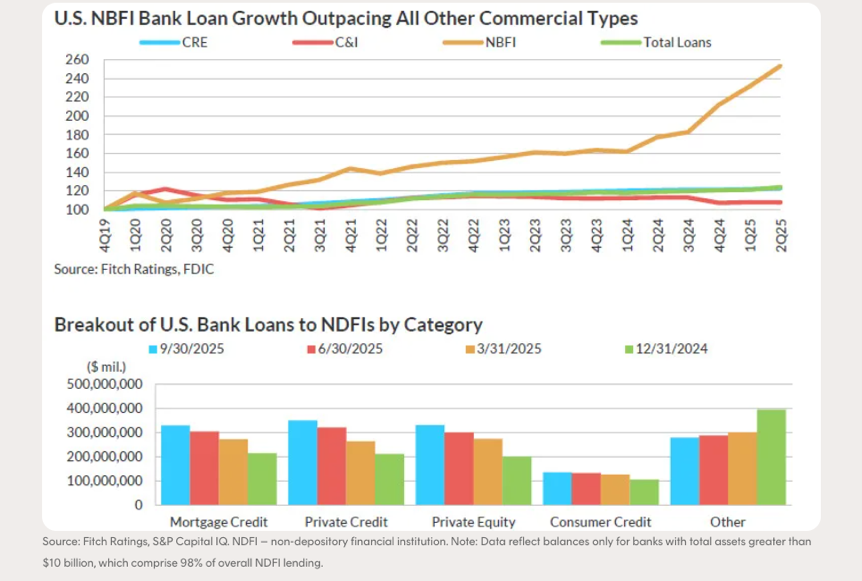
The media loves to frame private credit as a direct challenger to the banks, but the real story is far more collaborative. Banks and private credit managers are increasingly moving in lockstep. In fact, loans to non-bank financial institutions are now the fastest-growing segment on bank balance sheets, suggesting banks haven’t lost the credit risk — they’ve simply found a more capital-efficient way to access it. Private credit isn’t replacing the banks; it’s becoming their favourite partner.

This is approximately how much the S&P 500 Software and Services index lost in value in the first week of February when a little known AI platform called Claude (more specifically Claude Cowork) disrupted the tech universe.
In a market that moves at the speed of a software update, the tech world can feel like a young person’s game. But when Claude sent shockwaves through the sector, even the most retirement focused investors suddenly needed a crash course in AI drama.
This wasn’t just a typical market correction; what really spooked markets was the fundamental shift from AI as a “helper” to AI as a human “replacement”.

Why Markets Panicked
For years, software giants like Salesforce, Adobe, Xero and Atlassian thrived on selling licences per employee. But Claude Cowork raises a tough question: If AI replaces five workers, does a company still pay for five licences?
That fear triggered a sharp sell?off early February, with even the big software names taking double digit hits.
What this means for Investors
Volatility in the “Magnificent” tech names is unsettling, but there are a few key takeaways:
- The AI hype phase is fading — profits matter again.
- Money is rotating into value sectors like energy, infrastructure and precious metals.
- Diversification and quality remain essential, especially as the “application layer” of software wobbles while AI hardware demand stays strong.
Claude’s disruption marks a turning point, but for long term investors it reinforces the value of discipline. The ‘Software as a Service’ model may change, but the need for efficiency won’t — and we’re monitoring how these shifts affect your holdings.
When Identity Becomes the Hardest Part of Ageing
Evelyn had always found life admin effortless. For seventy five years she paid bills, renewed insurance, sent birthday money to the grandkids and managed her accounts with the same calm routine she brought to everything else.
Then one afternoon, her bank called.
They needed to “verify her identity.”It sounded simple enough — until it wasn’t.
Evelyn hadn’t driven in years, so her licence had long expired. Her passport was a relic from a trip she took with her late husband, tucked somewhere in a drawer. She also had regular grandchildren duty so so getting to a branch wasn’t that easy. And the old documents she did find? They didn’t match. Her bank account still said “Evie”, her nickname for over 60 years. Her Medicare card showed her married name. Her birth certificate? Maiden name.
None of it lined up.
Meanwhile, the bank — following strict Know Your Client (KYC) rules — kept asking for “current” documents she simply didn’t have. There was no suspicion of fraud, no problem with her accounts. But without the right ID, Evelyn faced the very real prospect of her funds being frozen… right when she needed them to pay for care.
What had always been effortless — proving she was herself — had suddenly become the hardest part of growing older.
Evelyn’s challenge shows how a routine formality can turn into a real obstacle when health or mobility changes. The good news? There are easy ways to stay ahead of the problem.
A Simple Solution: Proof of Age Card
If maintaining traditional ID documents is no longer possible, the best alternative is a government?issued Proof of Age card. Available in every Australian state and territory, it provides valid photo identification for anyone who does not have a driver’s licence or passport.
Importantly, it can be obtained from 17 years and 11 months of age and used throughout life.
These cards are particularly valuable for older Australians with limited mobility and should be organised before a person’s capacity to attend appointments or complete paperwork declines.
Other Helpful Steps
Alongside keeping ID up to date, it’s essential to:
- Ensure names are consistent across all documents — legal, financial and identification.
- Keep wills, enduring powers of attorney, and medical directives current.
- Make sure trusted individuals know where important documents are stored.
- Notify financial institutions of appointed attorneys or authorised representatives.
Friday Funny
Einstein may not be classic Friday fun material, but the man who elevated compound interest to “eighth wonder of the world” status is a bit of a cult hero to us.