
Disclaimer
Information provided on this website is general in nature and does not constitute financial advice. Every effort has been made to ensure that the information provided is accurate. Individuals must not rely on this information to make a financial or investment decision. Before making any decision, we recommend you consult a financial adviser to take into account your particular investment objectives, financial situation and individual needs.
A FinSec View – Who do you trust? Fossil fuels, good intentions and more.

|
It’s a question that used to have simpler answers. You trusted your doctor because they’d studied for a decade. You trusted your accountant because they’d seen your numbers for twenty years. You trusted the evening news because someone with a press pass had checked the facts before they went to air. In June 2026, the question is more interesting – and more consequential – than it’s been in a long time. More than half of Australians have now asked an AI chatbot about their money. Among pre-retirees, it’s 41%. That’s not a fringe behaviour anymore – it’s a shift in how people build understanding. And we’ll be honest: we use these tools in our own research, to sharpen our thinking, and to improve how we work. They’re brilliant for productivity and preparation. They’re terrible at answering the questions that matter most – the ones that depend on your circumstances, not the average case. Meanwhile, ASIC’s latest report tells us that nearly one in four Gen Z Australians holds crypto, two in three use social media for financial guidance, and trust in finfluencers sits at 52%. The paradox? This same generation ranks source credibility as their number one priority. They want trustworthy advice. They just aren’t finding it where they’re looking. And the stakes keep rising. A single fake tweet wiped $10 billion off Eli Lilly’s stock. Australians lose $2 billion a year to scams. Deloitte expects AI-enabled fraud to exceed US$40 billion globally by 2027. In a world where misinformation moves markets before correction can catch up, who you trust with your information – and who you trust to interpret it – has become a financial decision in its own right. This month’s edition sits squarely in that territory. The ATO just rewrote a 40-year understanding of holiday home deductions – and a quarter of a million property owners are about to find out what that means. The new superannuation tax for balances over $3 million – Division 296 – starts next month, and there’s a one-off concession that could shield decades of capital growth – but the practical deadline is 30 June, not the one on the form. An accountant modelled out the Budget’s proposed 30% minimum tax on trust distributions; the numbers tell a very different story from the headline. And Vanguard’s “Unlucky Steve” – who invested at the three worst moments in 25 years and still nearly quadrupled his money – is a reminder that the cost of waiting for certainty almost always exceeds the cost of being early. In the Market Update, the US and Australian equity markets are telling two completely different stories – and your portfolio lives in both. Our feature follows the money behind the AI revolution to a place the headlines aren’t looking: the power bill. When nearly two-thirds of data centre electricity in 2035 is still projected to come from gas and coal, the Net Zero targets and the demand projections start to look like they’re in different rooms entirely. There’s a theme running through all of it: complexity is rising, and the value of interpretation is rising with it. A recent EY global wealth study found that 45% of clients now see investing as more complex than two years ago, and one in five feel their adviser isn’t addressing their concerns. We read that and took it personally – in the best possible way. It’s why this publication exists: not to add to the noise, but to make sense of it. As always, we’d rather you read this and feel informed than read it and feel anxious. If anything in this edition raises a question about your own situation, that’s not a problem – that’s the point. Please pick up the phone. The only silly question is the one that isn’t asked. Enjoy the read. |
|
|
|
| We’re not going to rehash the monthly numbers — that’s what the weekly market update is for. What we want to talk about is the shape of the market right now, because if you hold a diversified portfolio — and whether you’re in a conservative allocation or high growth, you do — you’re straddling two very different stories at once.
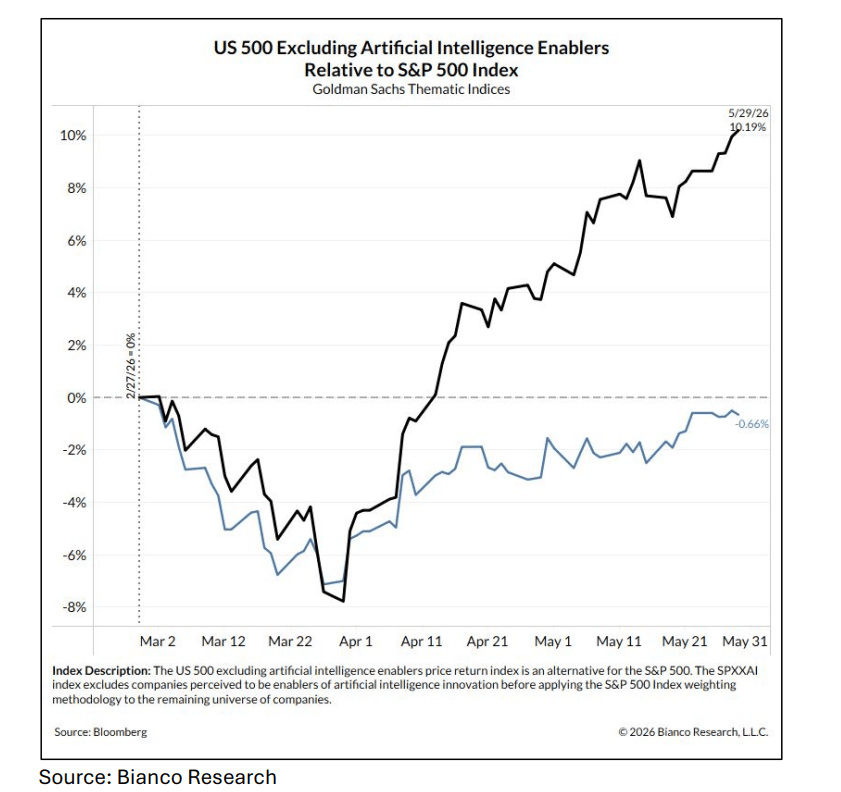
The US story is narrow and tech-led — and it’s dragging the broader international number with it. Overseas shares returned 18-22%+ hedged over the 12 months to May — the strongest performing asset class by a wide margin. But the headline masks the concentration underneath. Technology was responsible for almost all of the S&P 500’s advance in May and AI-related stocks now account for a record 45% of the index’s market capitalisation. Unlike the dotcom era, earnings are leading prices, not the other way around. The concentration is real, but it’s grounded in profits, not just promises. That said, strong earnings don’t guarantee sensible valuations — and the role of active management is to make sure you participate in the upside without being overexposed when the music stops. How narrow? Goldman Sachs launched an S&P 500 ex-AI index — the SPXXAI — in February. Since then, the headline S&P 500 has gained roughly 8%. The ex-AI version? Down nearly 2%. Over three years, the gap is even starker: the headline index returned 76% versus 32% for the version without AI enablers. The headline index and the lived experience of the average stock are telling two completely different stories. It’s the strongest argument for active management in years and one of the reasons we build portfolios the way we do.
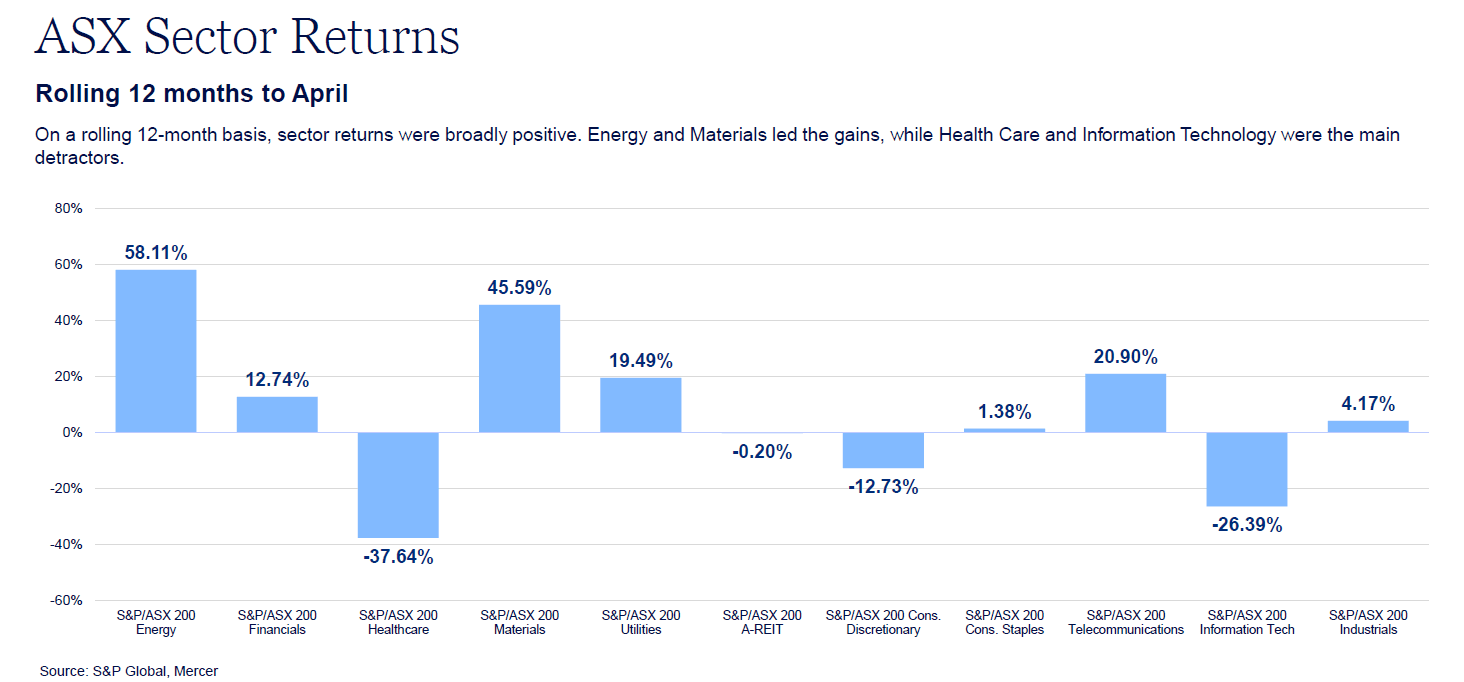
The Australian story looks nothing like it. Australian shares returned a more modest 7.5% over the same period – but the composition tells a very different story. Materials surged – up 10.5% in May alone, led by copper, gold, and industrial metals riding the AI infrastructure and energy transition story. Energy remains elevated over 12 months but has pulled back sharply from its highs as ceasefire hopes have grown – down nearly 6% in May. Financials have come under pressure, weighed down by rate hikes and softening credit growth. Meanwhile, Healthcare continues to crater down more than 30% year-to-date and remains the biggest sectoral drag on the index. This isn’t a tech rally it’s an old-economy story driven by the oil shock, the Middle East conflict, and a commodity cycle that’s reasserted itself.
If you only read the US headlines, you’d think you’re in a tech market. If you only checked your Australian holdings, you’d think you’re in a resources market. The truth is you’re in both — and the divergence between them is one of the strongest arguments for the diversified approach we build portfolios around. How much you feel it depends on your allocation: clients in growth or high-growth profiles have more riding on the equity divergence; those in conservative or balanced profiles are feeling the fixed income and cash repricing story more acutely. Either way, the moving parts matter. The backdrop is inflation and not the kind that’s fading fast. Australian CPI has eased 4.2% – down from a spike of 4.6% in March – but still well above the RBA’s 2-3% target. The headline number hides a split: goods inflation is easing, having moderated to 4.7% from 5.5% while services – the stickier, harder-to-fix kind – remains persistent at 3.5%. More concerning, the RBA’s preferred measure trimmed mean inflation actually rose to 3.4%, it’s highest since September 2024. That’s a problem a single interest rate lever struggles to solve.
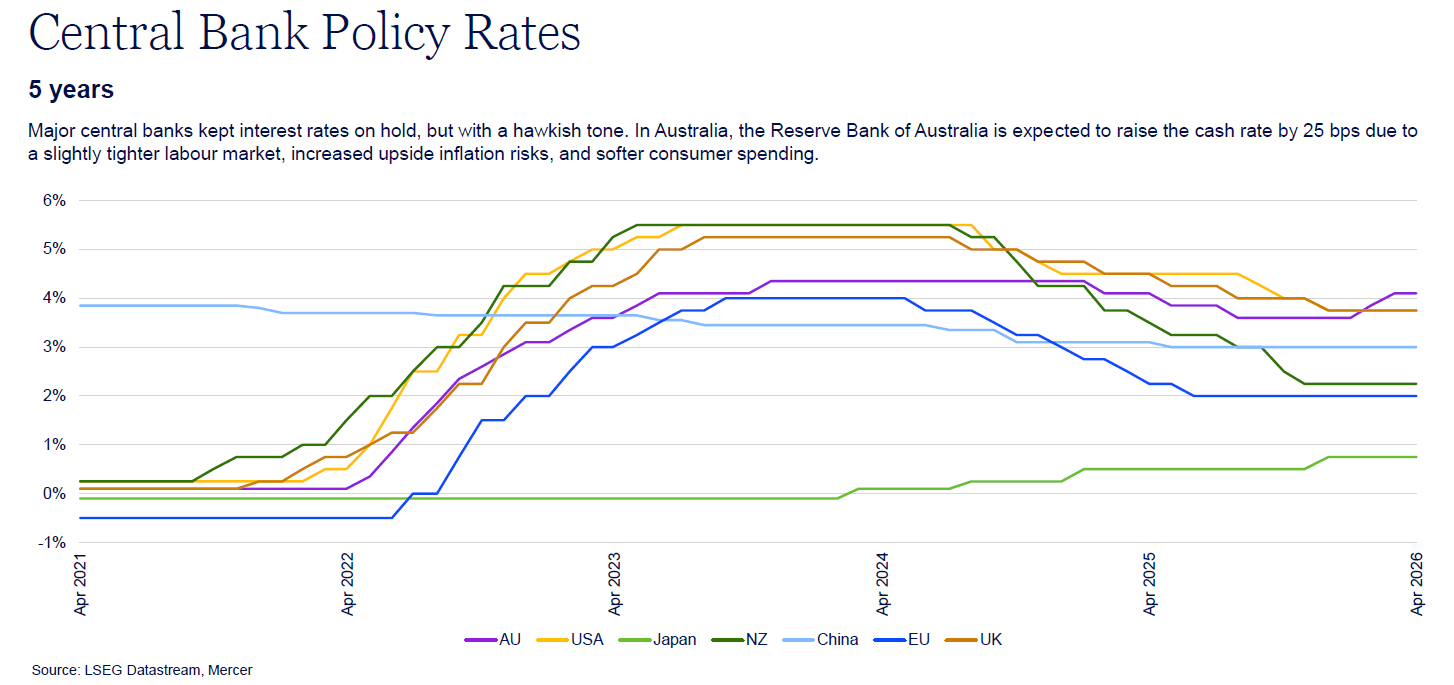
Which brings us to the RBA – and if this feels familiar, it should. Last month we noted Australia was swimming against the global tide on rates. That hasn’t changed – the current remains strong. The RBA has raised rates three times this year fully reversing the three cuts delivered in 2025. That’ s a remarkable pivot, and it’s happened while most major central banks hold. The Fed, under new Chair Kevin Warsh, hasn’t moved. The ECB and Bank of England have stayed put. The question now is whether the hiking cycle has peaked. Markets are pricing a roughly 75% chance the RBA holds at its June 16 meeting, and NAB has reversed its forecast entirely, now expecting the next move to be down, not up. But that doesn’t mean the pressure is off. Inflation remains above target, the labour market is only just beginning to soften, and at least two major banks still expect another hike before year-end. That reprices everything: bonds, property trusts, credit, and the opportunity cost of sitting in cash. For clients with international bond exposure, the picture is more nuanced – government bond yields in the US and UK are at near multi-decade highs meaning you can now earn up to 5% in some jurisdictions. When cash and bonds compete with equities on yield, the conversation about where to allocate defensively gets more interesting – and more important. We flagged the gap between sentiment and fundamentals last month and it’s now a chasm. Consumer confidence fell again in June — the Westpac-Melbourne Institute Index dropped to 80.6, among the weakest readings in the survey’s fifty-year history. Pessimists outnumber optimists by nearly 20%. Business confidence, while rebounding slightly in May to -14, remains negative across every industry — and profitability has now turned negative, a sign that cost pressures are squeezing margins. The labour market, which had been the economy’s shock absorber, is starting to show cracks: unemployment rose to 4.5% in April — the highest since late 2021 — with employment falling by nearly 19,000 in the month. Corporate earnings are holding up. But the psychology isn’t following the data, and that disconnect is now a trend, not a blip. It’s uncomfortable, and it’s exactly the kind of environment where discipline matters most.
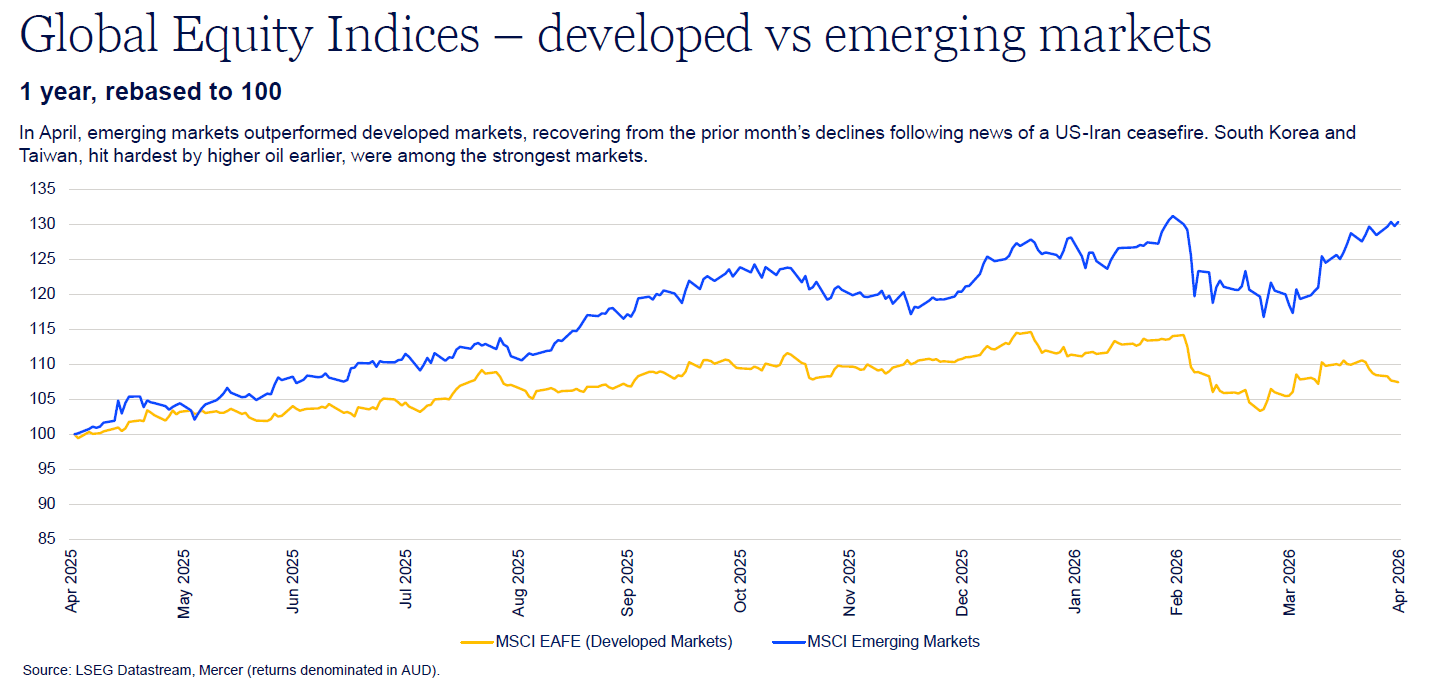
One more chart worth your attention. Emerging markets quietly outperformed developed markets through April and May – and the gap widened. In May, emerging markets returned 9.7%, comfortably outpacing developed markets at 4.6%. Korea and Taiwan both deeply embedded in the AI supply chain — led the rebound. For clients with international equity exposure, this is the diversification case showing up in real numbers, not just theory. Our view: A diversified portfolio is always going to have parts that are working and parts that feel like they’re not. That can be uncomfortable — especially when the divergence between markets is wider than usual. But this is precisely when diversification earns its keep. The ASX and the S&P 500 are in different chapters of different books. Your portfolio is designed to read both. |
|
|
|
| Designed to be skimmed. Your shortcut to being informed without the noise. Select “Read our take” for FinSec’s full interpretation.
How to Shield Your SMSF from Division 296 Legacy Capital Gains Tax Division 296 starts 1 July. There’s a one-off, irrevocable election that could shield decades of capital growth from the new tax — but it’s all-or-nothing, and five issues are being routinely missed. The formal deadline feels distant. The practical deadline is 30 June. ATO Finalises Strict New Tax Rules for Holiday Homes If your beach house is “available for rent” 11 months of the year but blocked over Christmas and Easter, the ATO just changed what that means — for the first time in 40 years. Around 250,000 properties are affected, and the deductions at stake go well beyond advertising costs. Trusts Aren’t Dead — But the Reason You Have One Just Got More Important The proposed 30% minimum tax on discretionary trusts has generated plenty of heat — and the tax implications are real. But there’s a second conversation that’s barely getting airtime: governance — control, protection, and what happens when life doesn’t follow the plan. We think both stories matter. Only one is being told. Even the Worst Possible Market Timing Beats Staying in Cash An investor who put money into the market at the three worst moments in 25 years — dotcom, GFC, COVID — still nearly quadrupled his capital. The same money in cash? Barely moved. Vanguard’s analysis is striking, but the real insight isn’t about luck. When to Trust AI With Your Money Questions (and When to Stop) More than half of Australians have already asked ChatGPT about their money. Among pre-retirees, it’s 41%. We think that’s a good thing — with one critical caveat. There’s a five-question test that tells you exactly where AI stops being helpful and starts being dangerous. Three Ways to Stop Fake News and Scams from Derailing Your Portfolio A single fake tweet wiped $10 billion off a company’s stock. Australians lose $2 billion a year to scams. And an Arup employee authorised a $50 million transaction on a video call with AI-generated deepfakes of his own executives. Your information diet is now a financial decision. ASIC’s Gen Z Report: Financially Engaged, Navigating Without a Map Nearly one in four Gen Z Australians now holds crypto. Two in three use social media for financial guidance. And yet they rank source credibility as their number one priority. ASIC’s latest data reveals a generation that wants trustworthy advice — and isn’t finding it where they’re looking. |
|
|
|
| Why AI’s Biggest Investment Story Isn’t About Chips
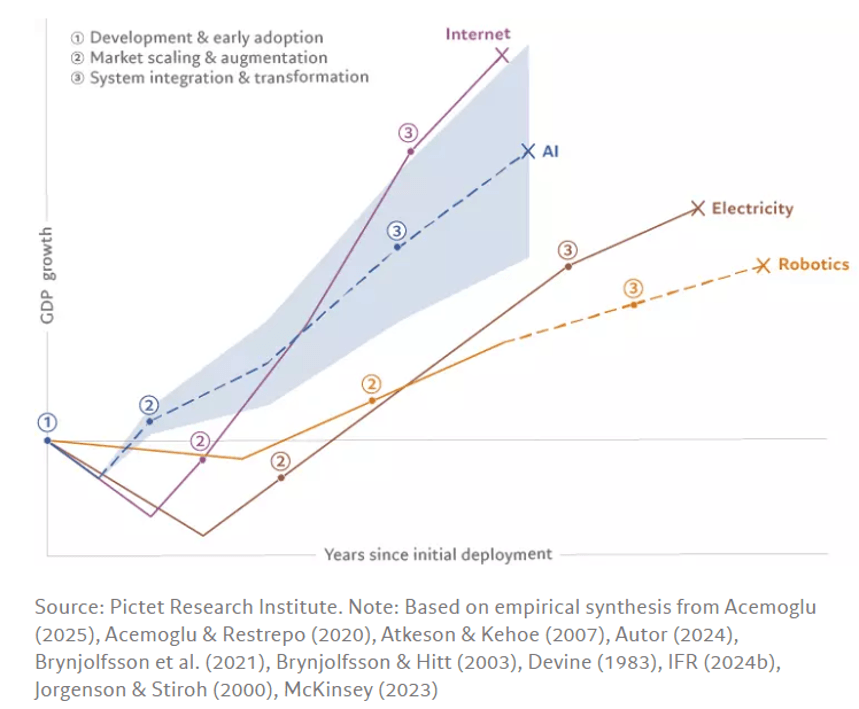
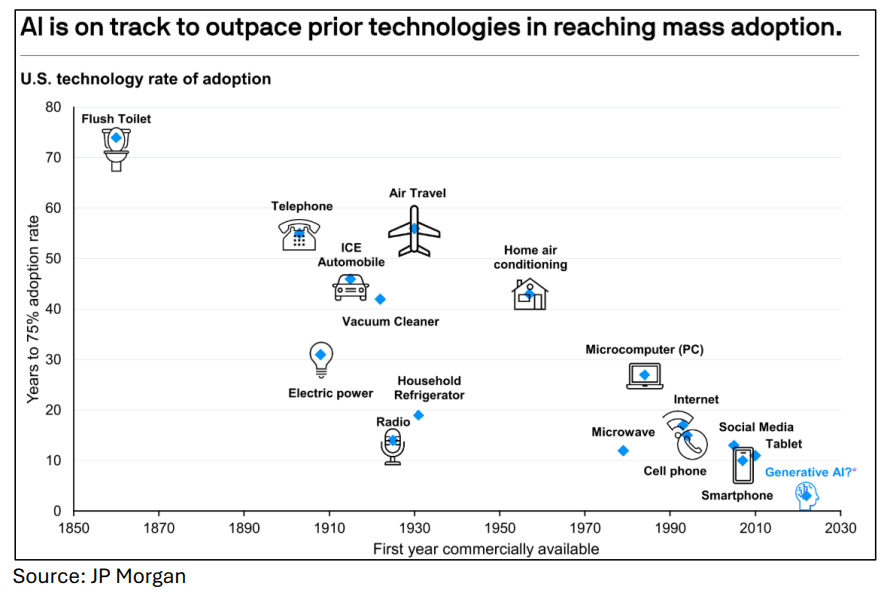
Every major technological revolution follows the same pattern. Heavy upfront investment. A messy, expensive middle. Then broad, lasting economic gains that dwarf the initial cost. Electricity did it. The internet did it. The chart above maps the pattern across a century — and the adoption curve always looks steeper in hindsight than it felt at the time. But here’s what makes this revolution different: it’s faster. JP Morgan’s adoption data (below) shows generative AI is on track to be the fastest technology diffusion in recorded history — reaching mass adoption more quickly than smartphones, social media, or the internet. The messy middle is still real. It’s just going to be shorter than usual.
But the most interesting part isn’t the technology. It’s the power bill — and the quiet contradiction at the heart of it.
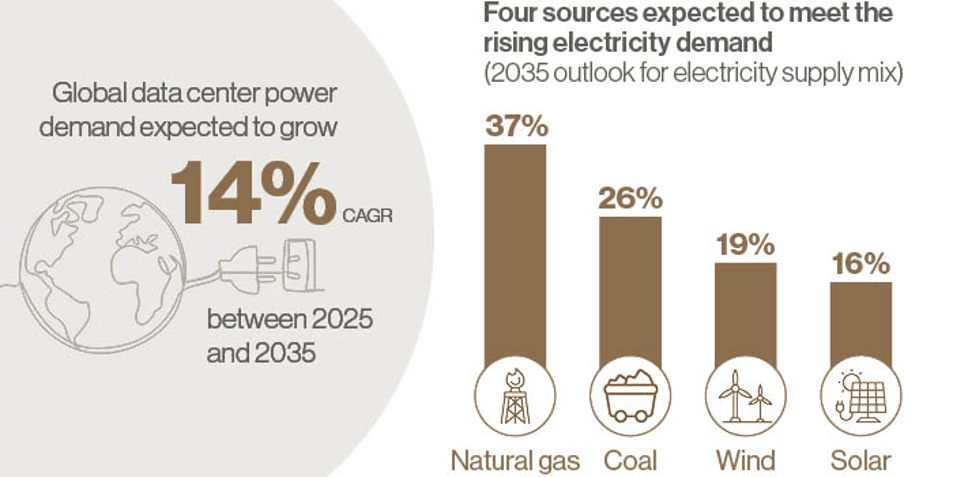
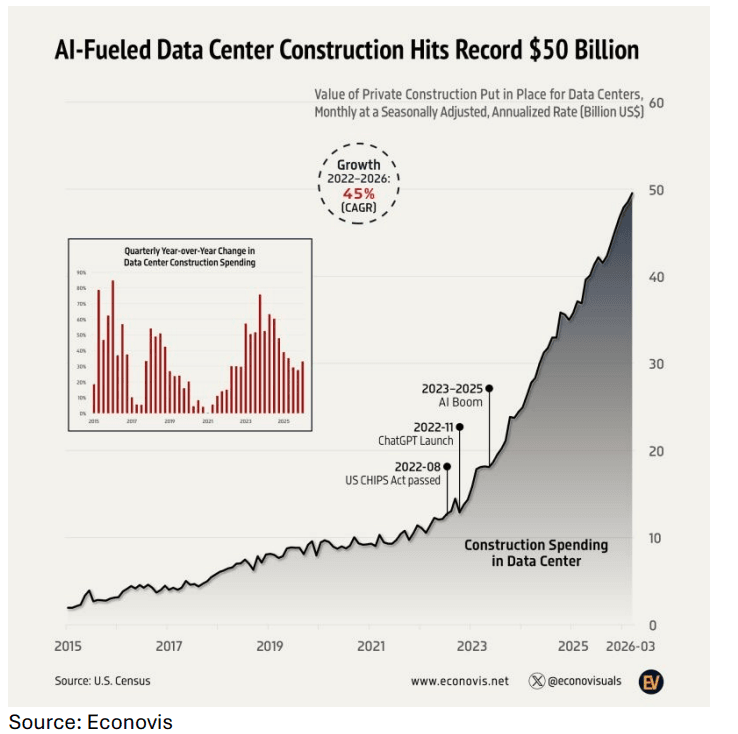
Source: IEA (International Energy Agency) – Energy and AI report, April 2026 Every AI query, every cloud workload, every time a system like ChatGPT is built or updated – it all requires electricity Electricity consumption from data centres is set to double by 2030, according to the International Energy Agency. That’s roughly equivalent to adding Japan’s entire electricity consumption to the global grid. The capital is already moving. Data centre construction spending in the US hit a record $50 billion annualised in early 2026 — growing at roughly 45% per year since 2022. That’s not a forecast. That’s steel in the ground. And they’re not paying for it out of pocket. Microsoft, Google, Amazon, and Meta have collectively borrowed over $100 billion this year to build the infrastructure. Mark Zuckerberg put it bluntly: he’d rather “misspend hundreds of billions” than be late to artificial superintelligence. Meta alone has committed an estimated $600 billion in data centres and AI hardware through 2028. When one CEO is willing to risk hundreds of billions on being wrong, that tells you something about how much they believe is at stake in being right.
The four largest sources expected to meet that demand by 2035? Natural gas, coal, wind, and solar — with fossil fuels still accounting for nearly two-thirds of the total. Nuclear — the technology Big Tech has collectively staked over $30 billion on — barely features. For anyone keeping score at home: the AI revolution currently runs on fossil fuels and good intentions. By 2035, it will run on fossil fuels and slightly better intentions. The Net Zero targets and the electricity demand projections are looking at each other from opposite sides of the room and pretending they haven’t met. Meanwhile, Microsoft is reportedly reconsidering its 100% clean energy target. Google’s emissions have surged 48% since 2019. The earliest Big Tech nuclear reactor doesn’t come online until 2027, and most small modular nuclear reactors are a 2030s story — by which time, according to the IEA chart, gas and coal will still be doing the heavy lifting. Every revolution has a bottleneck. For the internet, it was bandwidth. For electric vehicles, it was batteries. For AI, it’s kilowatts. And if history is any guide, bottlenecks are where the returns concentrate — because capital must flow to the constraint before it can flow to the application. To be clear: we’re all for burning less carbon. But as we noted in April’s edition, the Jevons paradox has a habit of showing up at exactly the wrong moment. In 1865, more efficient steam engines didn’t reduce coal consumption — they increased it, because cheaper energy found new uses faster than efficiency could save it. A century and a half later, AI is writing the same story in a different language. The technology gets smarter. The power bill gets bigger. The world doesn’t use less energy. It finds new reasons to use more. |
|
|
|

Same Technology, Different Planet The chart that reframes the entire conversation. In China, 83% believe AI products offer more benefits than drawbacks. In Indonesia, 80%. In Thailand, 77%. In Australia? Around 45%. In the US and Canada? Under 40%. The reason isn’t naivety — it’s aspiration. Developing economies see AI through the lens of what it gives: access to education, healthcare, financial services, and economic mobility that legacy systems never delivered. In India, AI tutors are bridging chronic gaps in education. In Nigeria, AI-powered tools are extending financial access to the unbanked. Over 80% of employees in India, China, Nigeria, and the UAE use AI at work — compared to far fewer in Australia and the US. Developed markets see it through the lens of what it takes away: jobs, privacy, control. Same technology, completely different emotional framing. Just as much of the developing world leapfrogged landlines and went straight to mobile, they’re now bypassing legacy software entirely and building AI-first. The adoption, the infrastructure demand, and the aspiration are global — and in many cases, the developing world is moving faster than the developed world knows how to feel about it. For investors, the implication is practical: the companies and economies capturing AI-driven growth may not be the ones dominating today’s headlines. Emerging markets already represent a meaningful component of a diversified portfolio — and the adoption gap suggests that’s not going to shrink. The aspiration economy doesn’t just explain a survey result. It explains a capital flow. |
|
|
|
| 1 in 400 Trillion
The odds of you, specifically, existing. That accounts for the probability of your parents meeting, the unbroken chain of your ancestors surviving long enough to have children, and every unlikely event that had to happen in exactly the right sequence across roughly 4 billion years of life on Earth. You’ve already won the longest odds in the universe. Everything else is just asset allocation. Source: Dr Ali Binazir, Harvard |
|
|
|
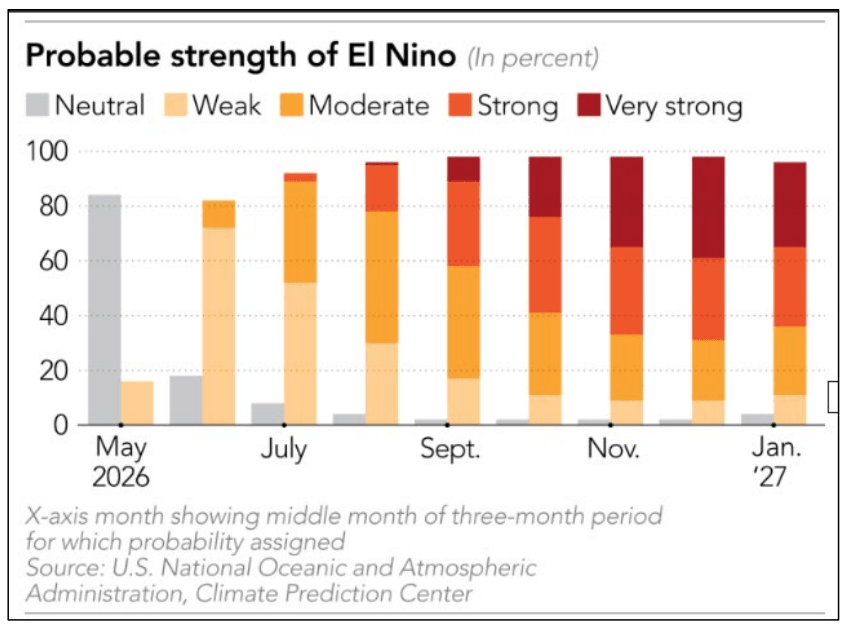
| If you’ve noticed Adelaide’s autumn has been unusually wet, enjoy it while it lasts. The World Meteorological Organisation confirmed this week that there’s an 80% probability of El Niño developing by August — rising to around 90% through November. The Bureau of Meteorology has flagged conditions could develop as early as this month. Some models suggest it could be one of the strongest on record, with subsurface ocean temperatures already exceeding 6°C above average.
The pattern typically means drier conditions, hotter springs, and a summer that tests everything from water allocations to insurance premiums. The last time a strong El Niño hit, Australian wheat yields dropped 44% in a single season. We’ll have more to say on this next month. For now, it’s the story that isn’t in the financial headlines yet — but we predict it will be.
|
|
|
|
Not Paris. Not London. Istanbul — with 23.4 million international visitors. Bangkok came second. Paris third. Something to keep in mind next time you’re planning a trip. The world isn’t getting smaller. It’s getting more interesting.
When Google first rolled out AI-generated answers in search results, one of its earliest recommendations was to add non-toxic glue to pizza for a crispier base. It also suggested eating one small rock per day for mineral intake. We’re told the technology has improved significantly since then. We’re also told that by the technology. For what it’s worth, the pizza advice still outperforms most crypto tips on social media.
A short essay arrived via a friend (Daryl Pratt) of the firm this month and stopped us in our tracks. The narrator wins a prize — then realises, with mild horror, that the category was essentially “being old.” What follows is a five-minute journey from indignation to revelation. The insight? Age isn’t a category to be managed. It’s evidence of value. The real asset, accumulated over decades, is earned perspective, judgment, resilience, and story. Experience is one of the most underleveraged forms of authority we have. If you’re 40, bookmark it and read again in 25 years. If you’re 65 and retired, read it now and feel quietly vindicated. Read the essay. See you next month. |