Disclaimer
Information provided on this website is general in nature and does not constitute financial advice. Every effort has been made to ensure that the information provided is accurate. Individuals must not rely on this information to make a financial or investment decision. Before making any decision, we recommend you consult a financial adviser to take into account your particular investment objectives, financial situation and individual needs.
A FinSec View – The obvious answer is often not the whole answer

|
The View – 17th July 2026 There is a parable about a man searching for his lost keys under a streetlight. A passer-by stopped to help and, after several minutes of unsuccessful searching, asked: “Are you sure you lost them here?” “No,” the man replied. “I lost them over there in the dark. But the light is much better here.” The story has endured because it captures something deeply human. We naturally gravitate towards what is easiest to see, measure and understand, even when the real answer might lie somewhere else. Financial conversations can be a little like that. Returns can be measured. Property values can be measured. Business valuations, super balances and income can all be measured. They matter, and we would be in the wrong profession if we suggested otherwise. Yet some of the most important conversations we have with clients are about things that don’t fit neatly into a spreadsheet. Fairness between children. Confidence about retirement. Knowing whether enough is enough. Deciding what comes next after selling a business. Understanding whether today’s market winners will justify tomorrow’s expectations. As we pulled together this month’s edition of The View, we realised many of the stories share a common thread. Markets have been strong, but a surprisingly small number of companies are carrying much of the weight. Significant wealth is being transferred between generations, yet many families are discovering that money does not necessarily make conversations easier. Business owners understand succession is important, but many are still waiting for the right time to start. And our feature article explores a debate that appears in every generation: did others really have it easier, or are we all comparing someone else’s advantages with our own constraints? None of these questions have simple answers. That is precisely what makes them interesting. At FinSec, the score still matters — clients need outcomes, not just explanations. But the score makes more sense when you understand the game being played. The headlines are important; they are simply not the whole story. More often, the real insight sits just beneath the surface. We hope you enjoy this month’s edition of The View. |
|
|
|
| The year belonged, again, to markets with the deepest AI exposure. You know that story — we told it last month.
So this month, rather than add to the noise, we want to show you something different. Not our view on AI, but the way we look at it before shaping advice about your money. The headlines measure the temperature — “is AI a bubble?” is now one of the most crowded questions in finance. We’d rather trace the plumbing. And there’s no better example right now than following the money.
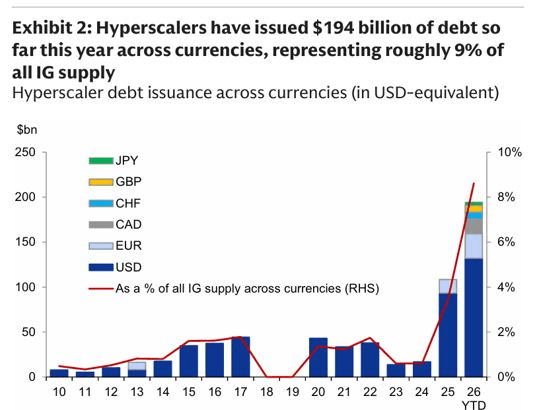
AI infrastructure companies have issued US$194 billion of high-quality corporate debt this year — about 9% of the global investment-grade (IG) bond market The circle Here is a sequence of transactions that took place over the past year, stripped of the jargon. Nvidia — which sells the chips — agreed to invest up to US$100 billion in OpenAI (source: Nvidia newsroom), the company behind ChatGPT. OpenAI, in turn, made commitments once reported at around US$1.4 trillion (Sam Altman, Co-founder and CEO OpenAI, Nov 2025) to build the vast computing capacity it needs. That capacity is built by cloud providers such as Oracle and CoreWeave. And to build it, they buy chips. From Nvidia. Read that again. Dollars leave Nvidia labelled “investment” and return labelled “revenue.” Analysts put the web of interlocking AI deals north of US$800 billion (NewStreet research). Even Goldman Sachs has flagged some of Nvidia’s arrangements as resembling “circular revenue.” None of it is illegal or even unwise — funding your own customers is a legitimate way to build an industry. But it changes how you read the headline. Record revenue usually means the world is buying. When some of it is the industry buying from itself, with money the seller supplied, the obvious answer isn’t the whole answer.
History rhymes We’ve seen this shape before. In the late 1990s, telecom makers like Lucent lent customers billions to buy Lucent’s gear. Revenue soared; the share price followed. Then the funding stopped — and much of it was never repaid. The revenue was real on paper. The demand wasn’t. We’re not forecasting that. Today’s AI leaders are genuinely, extraordinarily profitable — a crucial difference. But the pattern tells you where to look. In every boom, the hard question is rarely whether the technology is real. It’s whether the revenue is. The bill arrives later Even ignore the circle, and another number lingers. The four biggest cloud providers spent about US$434 billion on infrastructure in the year to March 2026, against roughly US$149 billion of depreciation. Servers wear out over five to six years — so today’s build will keep landing on future income statements. The spending is today’s fact; the bill arrives over time. But timing matters. Some managers who had been cautious on technology have recently softened that stance, not because valuation anxiety has disappeared, but because AI adoption has been faster than expected and data centre capacity has been harder to bring online. In plain English: demand may be strong enough, and supply constrained enough, for margins to hold up longer than first assumed. That does not remove the risk of future pressure as cheaper AI tools emerge and capacity catches up — it simply means the bill may arrive later, and less neatly, than the simple maths suggests. (Source: company filings (Amazon, Microsoft, Alphabet, Meta), year to March 2026; capital expenditure vs depreciation and amortisation. Compiled by Bloomberg / Financial Times, 2026). So what do we actually think? Here’s the honest part: we don’t know how the circle ends. It may unwind messily, or it may prove a perfectly rational way to build an industry that goes on to generate very real demand. Anyone who tells you with certainty is selling confidence, not insight. And that’s rather the point — we don’t build advice around guessing which way a story might break. We build it around what can be seen, tested and understood when we look under the cover. It’s also why we spread your money across more than one story — because leadership rarely stays in one place, and today’s certainty is often tomorrow’s cautionary tale. Our read: We’d rather understand the plumbing than simply measure the temperature. Money that travels in a circle can look a lot like growth — right up until it stops moving. Whether it does or not, we want to understand what keeps it moving before deciding how much confidence to place in the story. And if you want proof that leadership never stays still, you only have to look back a decade… |
|
|
|
| Nothing Is Ever Static
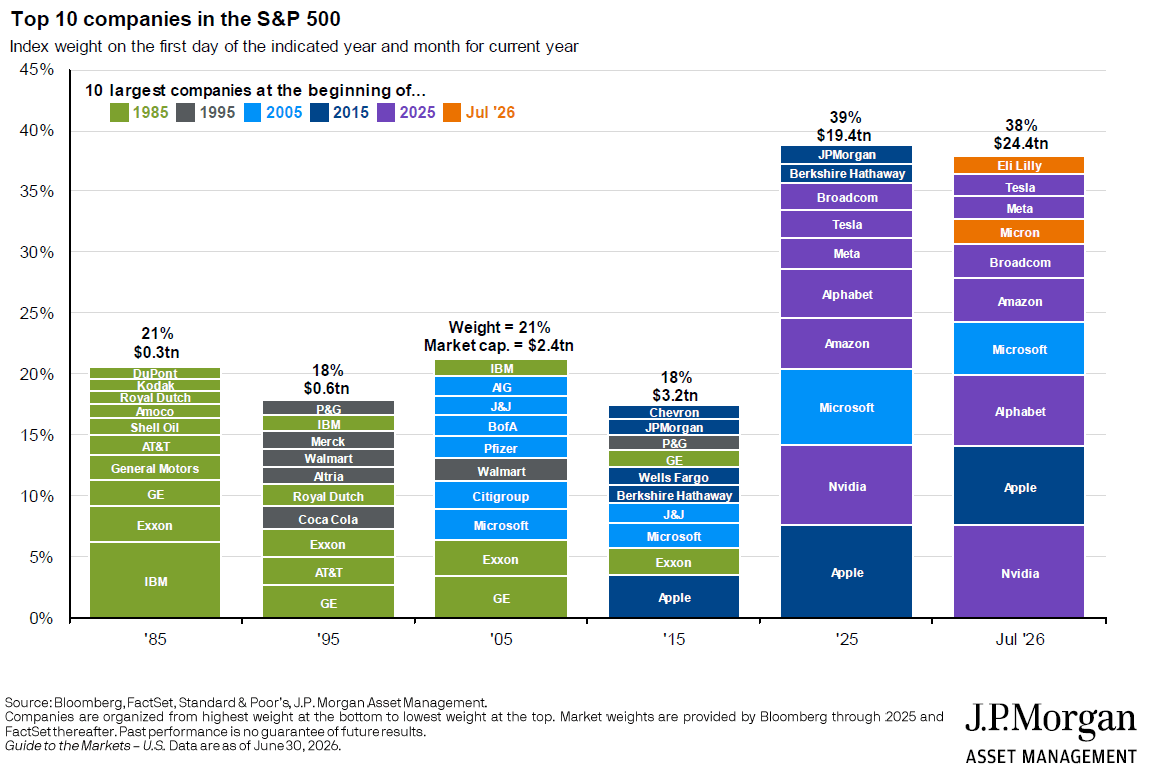
In 1985, the giants were industrial and energy names — IBM, Exxon, GE, Kodak. Today they’re almost all tech. Not one company from the 1985 top ten is still there today. Every single name has been replaced. Every era’s leaders felt permanent at the time. Oil in the ’80s. Financials in the 2000s. Tech today. The one constant is that the list keeps changing. The lesson: Don’t confuse today’s winners with tomorrow’s certainties. |
|
|
|
Designed to be skimmed. Your shortcut to being informed without the noise. Select “Read our take” for FinSec’s full interpretation.
Trusts Aren’t Dead — But the Reason You Have One Just Got More ImportantIn May, the Budget’s proposed 30% minimum tax had commentators declaring discretionary trusts finished. Then, on 18 June, the Government exempted discretionary testamentary trusts — quietly conceding the very distinction we’ve been making since May. The tax headlines are loud. The governance story is the one that compounds. Read our take Property in Super: The Ban the Budget Itself Set UpFrom 10 August 2026, SMSFs can no longer borrow to buy residential property. The curious part isn’t the ban — it’s how it came about: the Budget created the incentive, then the Budget’s own passage created the ban to close it. A tiny “loophole,” a last-minute deal, and a lesson in how policy really gets made. Read our take Things That Make You Go Mmm…When a Sydney Home Can Be Worth Ten Adelaide Homes A new proposal would count the family home towards the Age Pension — reviving an awkward question. Two retirees, same pension, wildly different wealth, purely by postcode. Whichever way you turn it, a single national rule collides with a very un-national property market. Read our take Someday Is Not a Succession Plan1.4 million Australian business owners will retire by 2036 — and a third have no plan. Global M&A may be running hot, but buyers are favouring fewer, bigger, better-prepared deals. With proposed CGT changes also putting timing under the microscope, succession planning is no longer something to leave for “someday”. Being unprepared doesn’t just risk a lower price; it can mean missing the window altogether. Read our take Budget Tracker: What’s Actually Law — and What’s Still Just TalkTwo months on from Budget night, the striking thing isn’t how much is still up in the air — it’s how much has already passed. From a financial services perspective only one major headline measure remains under consultation; the rest are law. Here’s the quick tracker, with dates, and what the pattern quietly tells us. Read our take |
|
|
|
| Why progress does not always feel like progress
Every generation thinks another had it easier. Younger Australians point to house prices, rents and living costs. Older Australians point back to double-digit mortgage rates, unemployment near 10%, and a world without instant information or cheap travel. Both are right — which is usually where the conversation stops being useful. The more interesting question isn’t who had it harder. It’s why so many Australians feel life has become harder, even as the country, on paper, keeps growing. That distinction matters. In the March quarter of 2026, GDP rose 0.3% and was 2.5% higher over the year — but GDP per person fell 0.1% in the quarter and rose just 1.0% over the year. Headline GDP tells us the size of the pie. GDP per capita tells us about the slice. And for many households, the slice hasn’t felt especially generous. That was the point in a recent article by Chief Investment Officer Scott Phillips (Motley Fool Australia) that caught our attention: much of the dissatisfaction Australians feel isn’t imagined. It reflects real pressures — weak productivity growth, stagnant real wages, softer growth per person, and the rising share of household budgets consumed by housing. Housing is the clearest example. According to the Australian Institute of Health and Welfare, Sydney’s median established house transfer price rose from around $680,000 in early 2014 to around $1.4 million by the end of 2024 — an annualised return of roughly 7.5%. High, yes, but not otherworldly. The sharper problem is that wages have been largely stagnant in real terms, so the gap between income and housing has widened. That is not just a property statistic — it is a family one. It changes when people leave home, when they start families, whether parents feel compelled to help, and what children come to expect. So the “who had it harder?” debate misses the point. Every generation inherits a different set of advantages and constraints. Previous generations had more affordable housing and stronger wage growth. Today’s have technology, information, investment access and flexibility that barely existed a few decades ago. The trouble is we compare one generation’s advantages with another’s disadvantages. We weigh cheap houses against today’s prices — rarely against 17% mortgage rates. We weigh today’s opportunity against yesterday’s simplicity. We rarely compare the whole picture. And in a world where social media feeds us more of what we already think, the debate becomes even harder to settle. Both sides are pointing at something real — but rarely at the whole picture. And when circumstances change, the family conversation has to change with them. For many families, this is already playing out at the kitchen table. Should parents help children into a home? Should support be a gift, a loan, or an advance on inheritance? Should it be equal, or reflect need? How do parents help without compromising their own retirement — and how do they offer assistance without creating entitlement? These are rarely just money questions. They’re about fairness, values, expectations and trust. Which is why the families who navigate them best aren’t always the wealthiest — they’re the ones willing to start the conversation before urgency forces it. The goal isn’t perfect agreement. It’s shared understanding. Perhaps that’s the real lesson. The question isn’t whether one generation had it harder than another. It’s whether different generations within the same family understand the challenges each other face. In a world where housing, wealth and opportunity are increasingly interconnected, that may be one of the most valuable investments a family can make.
Continuing the conversation Many of the themes raised here sit at the heart of our Intergenerational Wealth advisory service (IGW) — from family complexity and next generation engagement to transition readiness and coordination at transfer. If this resonates with your family situation and you’d like to learn more, please click here or speak with your FinSec adviser. |

|
|
|
| 173 Decibels
The volume of a blue whale’s call — louder than a jet engine (140dB) and detectable by other whales up to 1,600 kilometres away. They’ve been communicating across entire ocean basins for 50 million years without a single subscription, algorithm, or content strategy. Arguably the most effective broadcast network on earth. And they never post on LinkedIn. |
|
|
|
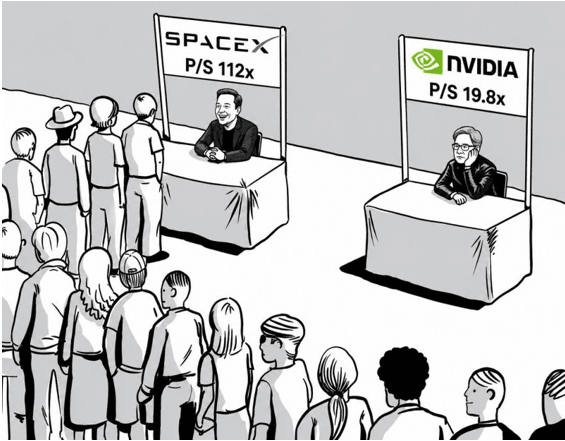
Remember when Nvidia was the exciting story? Apparently that was ‘so yesterday’. A cartoon making the rounds this month shows investors queuing to buy SpaceX at eye-watering valuations while Nvidia — one of the greatest stock market success stories in history — sits quietly by itself wondering what happened. Markets move fast. FOMO moves faster.
Source: LinkedIn (circulating widely in July 2026)
Neil — the 1,000kg southern elephant seal who hauls himself onto Tasmanian roads, driveways and the occasional front lawn each winter — has once again flattened bollards, crushed fences and stopped traffic, all to the delight of millions online, before sliding back out to sea. As one Tasmanian senator put it, he’s “the only bloke in Tasmania who can stop traffic, ignore everyone and still be loved for it.” No portfolio. No plan. No postcode anxiety. Some weeks, that’s the dream. Watch Neil in action .
|