Disclaimer
Information provided on this website is general in nature and does not constitute financial advice. Every effort has been made to ensure that the information provided is accurate. Individuals must not rely on this information to make a financial or investment decision. Before making any decision, we recommend you consult a financial adviser to take into account your particular investment objectives, financial situation and individual needs.
A FinSec View – A consequential Budget, calm markets, messy reality and more

| 15th May 2026 |
| There was only ever going to be one big-ticket item this week, and the Federal Budget duly arrived with enough tax reform, housing politics and capital reshuffling to keep advisers, investors and accountants occupied for quite some time.
What perhaps wasn’t clear until the detail landed is quite how much of it would need to be digested not just at the headline level, but at the level where incentives shift, structures get rethought, and entire strategies start quietly moving around. This was not a budget of minor tweaks and cosmetic reform. The proposed changes to capital gains tax, discretionary trusts and negative gearing go to the architecture of how Australians invest, hold assets and plan across generations. And while the political framing is all intergenerational fairness and better housing outcomes, the practical reality is already looking rather more complicated. External commentary has been quick to flag likely behavioural responses: restructuring into companies or super, pressure on rents, uneven treatment between existing and new investors, and a fair amount of confusion for the people now expected to implement all of this cleanly. As for unintended consequences, several are already queueing politely at the door. Beyond the Budget, there is no shortage of noise: rate speculation, market rebounds, geopolitical flare-ups, and the usual confident declarations that everything is either about to improve dramatically or fall apart by Thursday. But the more useful story this month may be something less theatrical: friction. Not collapse. Not crisis. Just a world in which more things take longer, cost more, and involve more moving parts than they used to. Markets are adjusting to uncertainty as a permanent feature rather than a temporary interruption. Households are discovering that “higher for longer” sounds much more elegant than it feels. And policymakers, as ever, remain better at announcing measures than removing the practical drag around them. That is the thread running through this month’s View. Because right now, the question is not simply what is changing. It is where friction is building — and where good advice helps remove it before it becomes expensive, stressful, or both. |
|
|
|
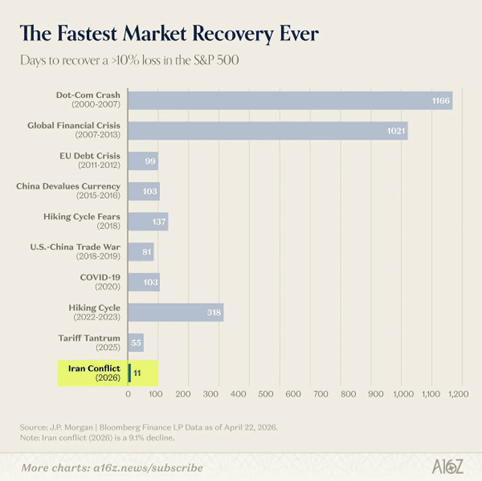
| Markets have looked almost oddly relaxed in the face of rising geopolitical tension.
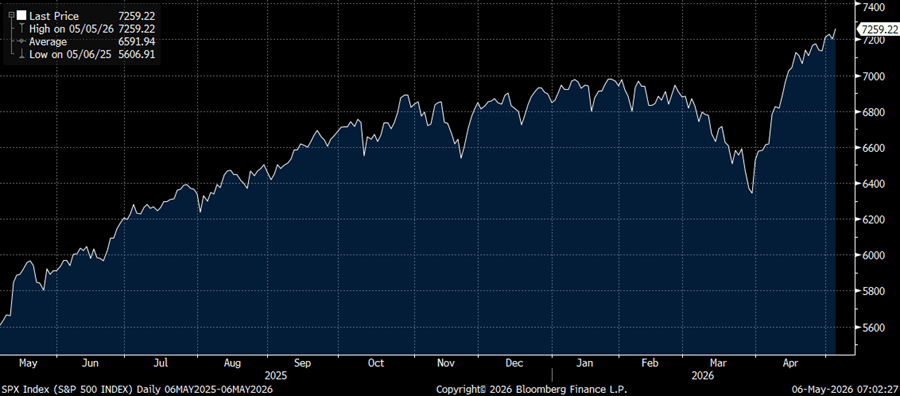
The speed of the latest rebound only adds to that impression. Markets have recovered faster than they did after almost any other major shock. But that calm can flatter to deceive.
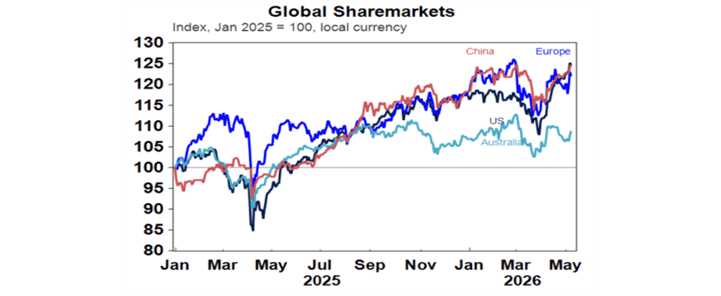
“Less bad” is enough Markets right now feel a bit like a wedding with a bad DJ: average all evening, then ABBA’s Dancing Queen comes on and the room erupts as though it’s the encore. That, more or less, is the mood. A ceasefire headline or a 90-day tariff pause is not exactly good news. It is simply less bad. And after months of elevated uncertainty, that has been enough to keep pushing markets higher, including sending the S&P 500 back to record levels.
Source: Macrobond and AMP Not complacent—just repricing risk differently You could call that complacency. A better explanation is that markets have simply recalibrated. In the old regime, risk arrived as a shock:
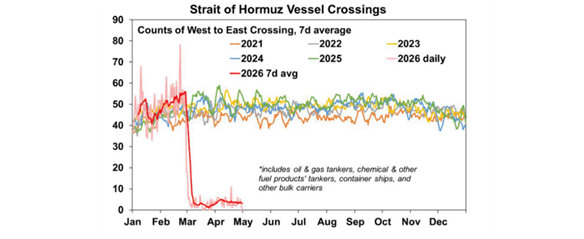
In this environment, uncertainty is no longer episodic. It is just there all the time. Markets are reacting less to each individual headline and more to the idea that uncertainty itself now sits permanently in the price. Beneath the calm, the system is already adjusting. The Strait of Hormuz is a useful example. Markets have pushed higher, but there is still very little traffic moving through the region. In other words, the physical system is under strain even if financial markets are not especially interested in panicking about it. That matters because even when a conflict de-escalates, it does not un-happen. The immediate shock premium may fade. The resilience premium tends to stick around.
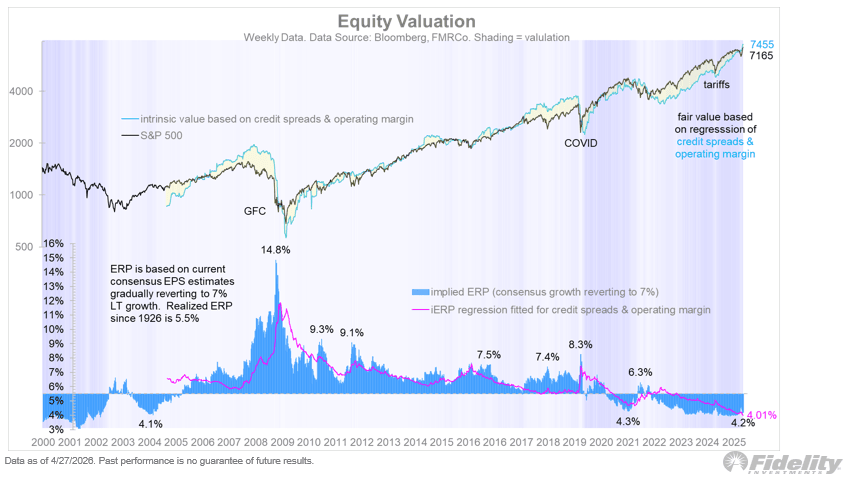
Source: Macrobond and AMP Another reason markets can keep grinding higher is valuation. US equities are not cheap in any nostalgic sense, but nor are they uniformly absurd.
(How to read this: the black line shows how richly the S&P 500 is being valued relative to bond yields. The blue line is a model-based guide derived from credit spreads and company operating margins. When the two lines move together, valuations are broadly aligned with fundamentals. When the black line sits materially above the blue, investors are paying more for equities than that backdrop would normally support). Another reason: inflation has not disappeared. Markets have just learned to live with it. Inflation is still a constraint, but its role has changed. Instead of automatically knocking markets over, it is now being treated as something that can be managed through monetary policy, absorbed through earnings and pricing power, and partly carried by nominal growth. Historically, equities can still do reasonably well in that sort of setup, especially when inflation is stabilising rather than flaring up again.
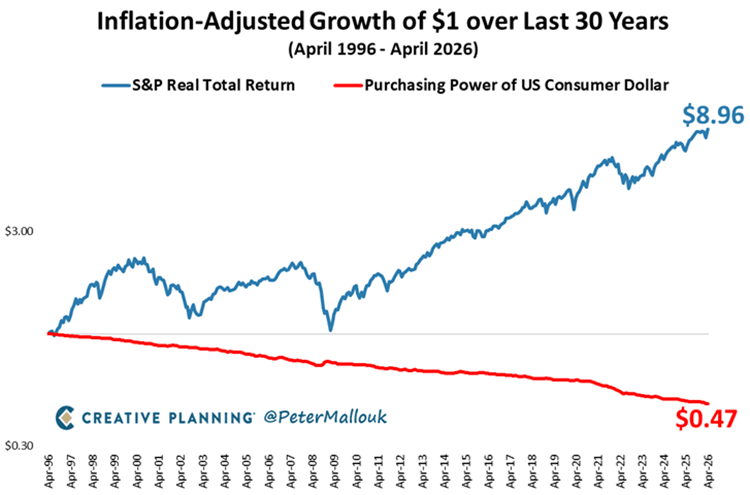
Source: Creative Planning And probably the number one reason: the S&P 500 is still climbing what Pinnacle’s Chief Investment Officer called the “stairway to AI Heaven”. That theme has given investors a clean earnings story to hold onto, even while the macro backdrop remains a bit untidy. It has concentrated returns, yes, but it is also another reason markets can keep rising in the face of uncertainty.
Source: Bloomberg, Peter Mallouk What to watch from here The key risk is not that markets are ignoring reality. It is that they are currently pricing in a fairly benign version of it: de-escalation as the most likely path, policy credibility as broadly intact, and growth as resilient enough to absorb higher costs. If those assumptions shift, markets may yet lose their cool. So no, markets are not necessarily complacent. They have simply stopped treating uncertainty as a one-off event and started functioning with it. That is the shift. For ongoing commentary on markets and the economy – refer to the weekly market update here. |
|
|
|

The Budget debate has become moralised rather quickly. That is usually not a great sign. The debate over the Budget was always going to be heated. Measures touching housing, tax and intergenerational wealth rarely pass quietly, and nor should they. Many Australians — especially younger ones — feel locked out of the sort of financial progress previous generations took more for granted. That frustration is real, and pretending otherwise is not serious analysis. But serious analysis is exactly what the debate now requires — and grievance is not a substitute for it. Too much of the reaction has already fallen into two familiar camps: tax the wealthy because they must have had it too good, or defend every concession as though any change is an assault on virtue itself. Neither position is especially useful. One reduces policy to resentment. The other treats the current system as though it emerged in perfect form from the heavens. The more useful question is whether these changes actually address the problems they claim to solve — and at what cost. Tax policy does not operate in a vacuum. It shapes behaviour. It changes incentives. It affects where capital goes, how assets are held, when people invest, and whether people still believe the long-term rules of the game are broadly coherent. That matters more than the moral satisfaction of landing a political message on the right cohort. Housing affordability is clearly the central pressure point. The decline in confidence among younger Australians that hard work will translate into a better life is not imagined. And that erosion matters, because when belief in progress fades, people behave differently. They save differently, work differently, invest differently, and sometimes disengage altogether. A healthy society needs more than redistribution. It needs a credible sense that effort, patience and prudent risk-taking still have a pathway to reward. As Charlie Munger famously put it, “Show me the incentive and I’ll show you the outcome.” That is why major tax changes should be judged not just by who they target, but by the incentives they create and the behaviour they ultimately produce. If the effect is to improve access and fairness without damaging confidence, investment or supply, that may be a trade-off worth making. But if the likely result is more complexity, more distortion, more restructuring and a fresh round of unintended consequences queueing politely at the door, then the debate should be a good deal more rigorous than it has been so far. None of this is an argument for no change. Tax policy is not a contract, and governments are entitled to redraw the settings. But wealth-building is a long-term exercise, and long-term behaviour depends in part on trust: trust that the rules are reasonably stable, that sacrifice today still improves tomorrow, and that the system rewards more than grievance and timing. The test for these measures is not whether they are politically satisfying. It is whether they actually improve affordability, opportunity and confidence without creating a fresh crop of distortions dressed up as fairness. Governments are very good at announcing reform. The harder trick is designing it so the second-order effects do not become the real story. |
|
|
|
| This is The Skim — our quick take on the technical updates and stories worth knowing. Designed to be skimmed, obviously, it is the shortcut to staying informed without the noise or the mental clutter. How to stop your kids and grandkids being taxed like CEOs The AFR turned this into a headline because it captures a surprisingly easy mistake to make: putting investments in a child’s name can trigger some fairly nasty tax outcomes. In Australia, minors generally do not get the standard adult tax-free threshold on passive income, which means dividends, interest and some trust distributions can be taxed at penal rates. So this is less a story about generosity than structure. The real issue is not whether wealth is being passed on, but where assets sit, who controls them and when income is recognised — whether through personal ownership, trusts, investment bonds, super or later-stage transfers. Worth checking with your adviser before investing in a child or grandchild’s name, using a family trust for distributions, setting up investment bonds, or moving assets between generations. In family wealth planning, tax, control and intent have a habit of travelling together. Insurance claims are where advice proves its value APRA’s latest life insurance claims data suggests advised clients continue to fare better than non-advised policyholders, especially on more complex claims such as TPD, where acceptance rates, resolution times and dispute outcomes tend to be stronger in the advised channel. That likely reflects the complexity of the claims process, where documentation, policy definitions and insurer engagement can materially shape outcomes. That is a useful reminder that insurance value is not just about having cover. It is about getting ownership, definitions and implementation right well before a claim ever arrives. When life gets messy, that is usually where the value of advice becomes very obvious, very quickly. Keeping your Seniors Health Card as deeming rates rise Two months on from the 20 March 2026 deeming rate increase, this is becoming a live issue for self-funded retirees. The story is not that investment income has magically jumped. It is that the government may now assess some retirees as earning more, which can push them closer to — or over — the Commonwealth Seniors Health Card income threshold. It is a neat example of how small technical settings can create very real-world consequences. When clients are sitting near a threshold, minor rule changes have a habit of becoming major annoyances. For the latest deeming rate information, click here — or speak with your adviser if you are unsure whether the change could affect you. EOFY super opportunities often come down to timing, not just strategy As 30 June approaches, contribution caps, pension minimums and fund receipt timing all start to matter. A sensible strategy can still come unstuck if paperwork, cashflow or processing deadlines are left until the final stretch. EOFY is often less about doing something clever than doing the right things properly — especially where contributions, deductions and super structure intersect. With the deadline now uncomfortably visible, it is a good time to check whether any intended strategies still need to be actioned. Key changes from 1 July 2026 Key super and tax changes to be across from the new financial year include a mix of confirmed measures and proposals still subject to legislation:
Key aged care changes to be across include:
|
|
|
|
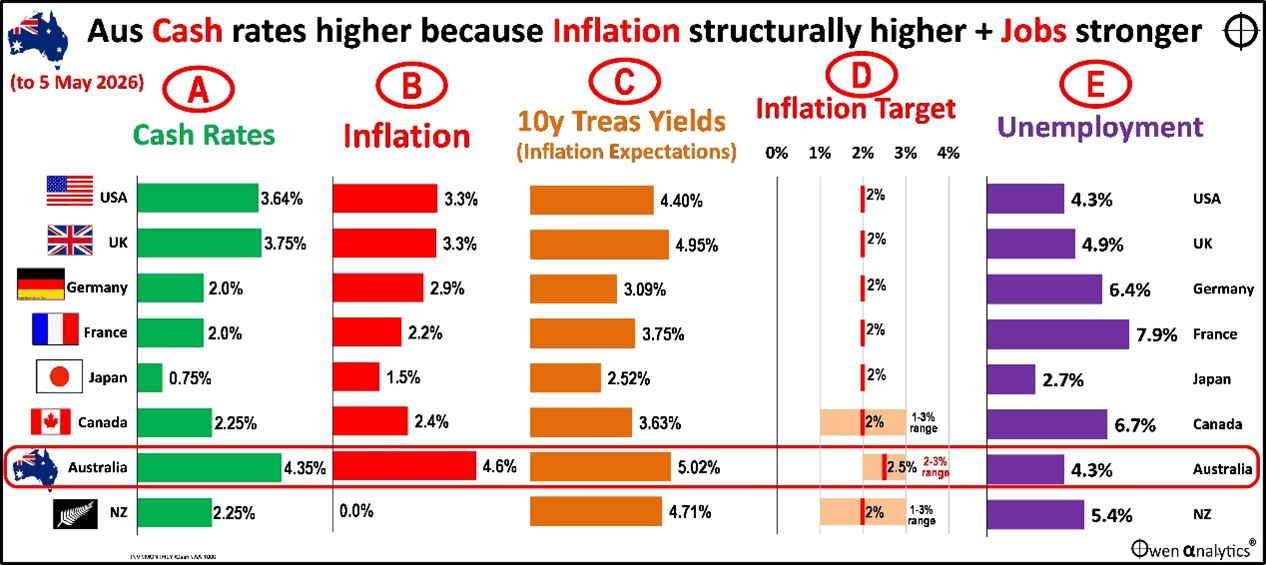
| Australia’s cash rate is already high by advanced-economy standards — in fact, it now sits at the top of the rich-world pack.
And, because Australian mortgages are mostly variable, with relatively short fixed terms and high household debt, rate rises hit here faster than they do in many peer economies. That makes “higher for longer” less an abstract macro debate and more a very real household cashflow story. So why is Australia running a higher cash rate than most of its rich-world peers? The short answer is that inflation has been stickier, the labour market stronger and policy settings looser for longer. Put together, those forces help explain why the Reserve Bank still appears to have more work to do than many of its counterparts. Five factors sit behind the story:
Source: Owens Analytics Bottom line: inflation in Australia is proving sticky enough that rates may stay higher for longer — and could go higher still if price pressures are slower to retreat than hoped. The lesson from the 1970s is that letting inflation linger rarely ends well. The eventual cure is usually more painful than dealing with it early. That is why the RBA is still giving priority to bringing it down now, even if the burden falls unevenly. In an ideal world, fiscal policy would share more of the load. In the real one, fiscal restraint is not good politics and so central banks are often left holding the blunt instrument. |
|
|
|
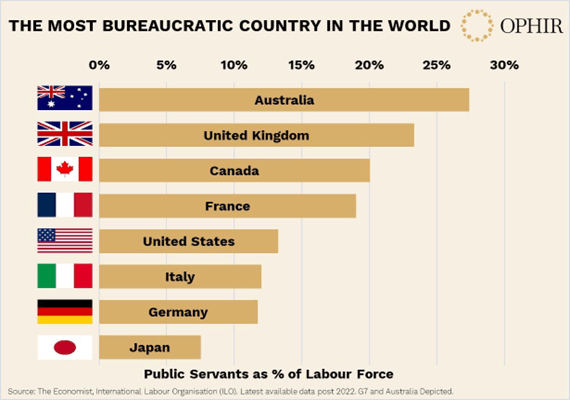
| 27%
Is the number of public servants in Australia as a share of the labour force There is a chart doing the rounds this week from Ophir Asset Management, and it is not exactly a love letter to productivity. Australia has more public servants, as a share of the labour force, than any country in the G7. Twenty-seven per cent. The US sits closer to 12. Japan is around 6. That does not automatically mean the public sector is “too big”, but it does tell you something about where labour has been flowing — and why the private economy can feel like it is trying to hire with one hand tied behind its back. And that is really the broader point: productivity rarely dies in one dramatic moment. More often it gets quietly sanded down by friction — slower decisions, more process, more layers, and fewer people doing the practical work that actually moves things forward. As one speaker put it last week, red tape and compliance now consume so much time that many workers are effectively spending 57% of their day “doing work about work”.
|
|
|
|

A fairly efficient summary of the modern economy: plenty of activity, plenty of process, and not always a great deal of progress. |
|
|
|
Part diary, part field report from someone who has spent a career thinking about retirement — and has now had the good sense to test the theory. A timely reminder that the emotional adjustment can be just as real as the financial one. Read here https://www.firstlinks.com.au/two-months-into-retirement
Another nod to retirement: once work stops structuring the week, many people imagine they will finally read more. Whether that turns into Tolstoy, theology or just re-reading thrillers with better light is another matter entirely. However, the world’s most printed books are not exactly a gentle little summer list. It is an eclectic mix of scripture, ideology, fantasy, children’s fiction and the occasional brick-sized classic — which feels like a fairly accurate snapshot of humanity: earnest, escapist, contradictory, and very keen to buy books we fully intend to read one day.
Source: David William Scott, Williams IM
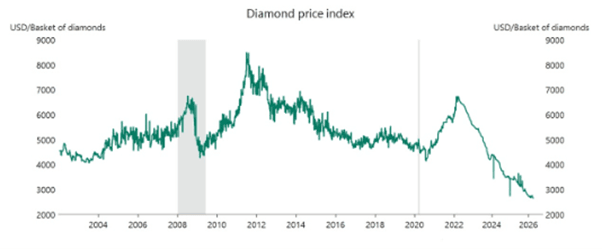
And while we are on life’s major milestones: diamond prices are way down, according to Apollo — which is either a market observation or a public service announcement, depending on where you are in life. Not every chart needs to be useful, but this one may yet prove unexpectedly practical.
Source: Apollo And that will do for this month: Retirement, literature and cheaper diamonds — which, taken together, feels like a fairly complete life plan. |